

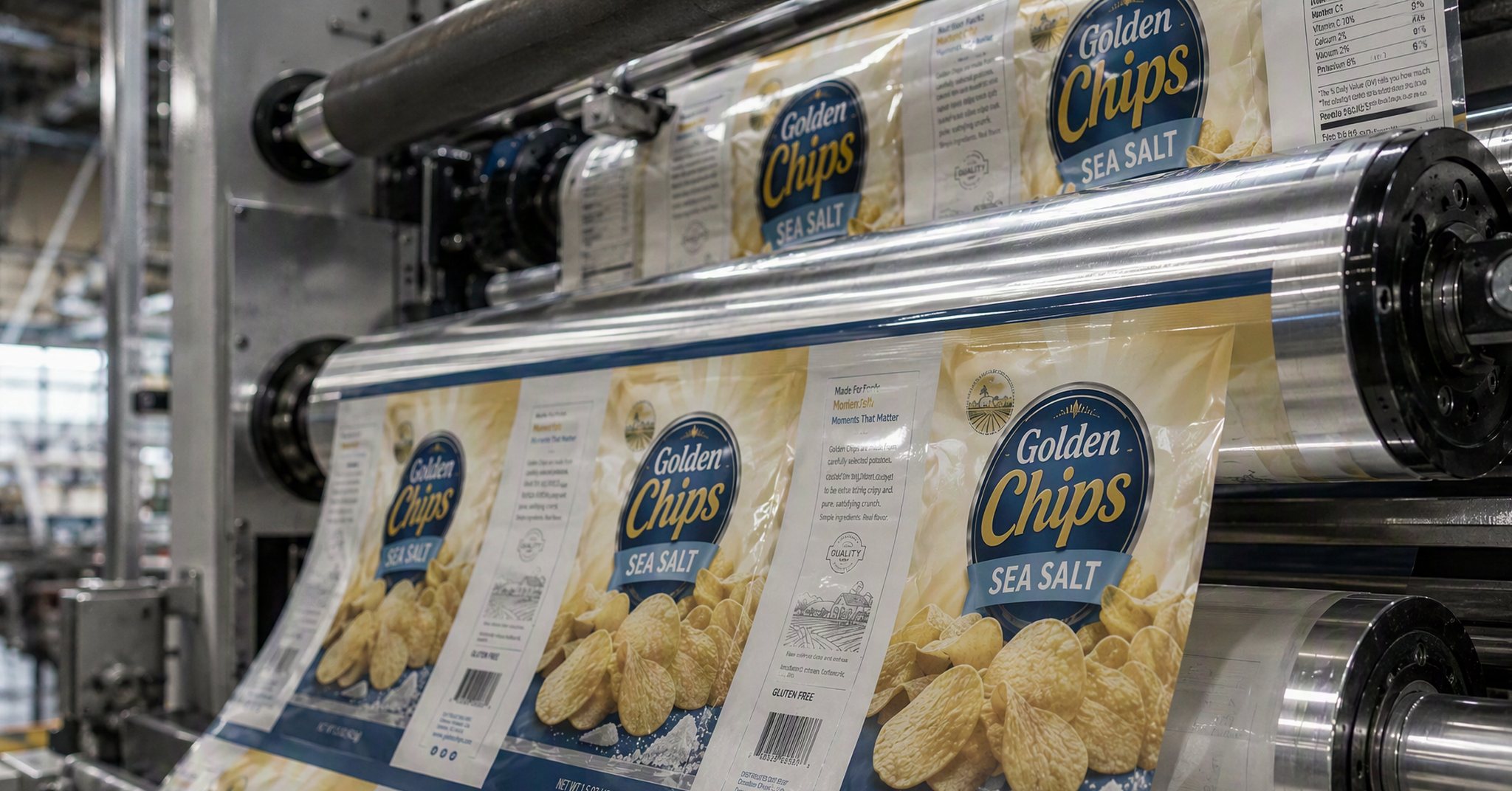
Flexible packaging film lamination
Keneng Print — Knowledge

Specify with
confidence.

Eight practical briefings from the converting floor and the regulation desk — the same guidance our engineers give customers, published openly.

Briefing 01 — Format selection

How to choose the right pouch format

The format decides shelf presence, filling speed and unit cost before the artwork does.

Every pouch format is a trade-off between shelf presence, filling technology and cost. Stand-up pouches dominate because they combine strong retail visibility with resealable convenience at a moderate unit cost. Flat bottom (box) pouches cost more but stand firmer and read more premium. Pillow and flat pouches are the economy choice for high-speed, single-serve lines.

Match the format to the product

  • Snacks, nuts, dried fruit — stand-up pouches with zippers; pillow pouches for high-volume single-serve.
  • Coffee — flat bottom or side gusset with a degassing valve; stand-up for retail sizes.
  • Liquids, purées, baby food — spout pouches with caps; hot-fill structures where needed.
  • Shelf-stable meals — retort pouches, foil or clear high-barrier.
  • Bulk & pet food — quad seal or flat bottom for 2–10 kg fills.
  • Samples & condiments — three-side seal sachets and stick packs.

Then check the production reality

Volume, filling equipment and budget close the decision. High volumes on existing VFFS/HFFS lines point to rollstock; manual or semi-automatic filling favors pre-made pouches; liquids need spout compatibility with your filler. When in doubt, run samples of two or three formats with your actual product before committing.

Keneng perspectivePremade pouches and form-fill-seal rollstock suit different jobs. Rollstock wins on line speed and unit cost. Premade pouches win on appearance: they are formed and sealed under controlled conditions, so edges stay crisp and seals stay straight — like a tailored suit — while forming a pouch on the filling line can leave overheated edges and curved seals. If shelf impact matters most, choose premade. We make both.
References: pouch-type selection frameworks from industry converters and the Flexible Packaging Association's format resources — flexpack.org.
Briefing 02 — Sustainability

The case for flexible packaging

Measured across the full life cycle, flexible formats are often the lightest-touch option on the shelf.

Sustainability in packaging is dominated by source reduction: using less material in the first place. Here flexible packaging excels. Because a pouch is mostly product and very little package, its product-to-package ratio outperforms nearly every rigid alternative — a single-serve drink pouch can be only a few percent packaging by weight, where a glass bottle is typically a third or more.

The logistics multiply the benefit. Unfilled flexible packaging ships flat: film for an entire production run can arrive on one pallet where rigid containers would need dozens. Less weight and less air means measurably lower transport emissions.

Protection is prevention

The U.S. EPA's Wasted Food Scale ranks prevention above recycling and composting — and packaging's biggest environmental service is keeping food usable. High-barrier films, vacuum and modified-atmosphere formats extend shelf life and cut spoilage, which frequently outweighs the package's own footprint.

Sources: Flexible Packaging Association, sustainability & life-cycle research — flexpack.org/sustainability; U.S. EPA Wasted Food Scale — epa.gov.
Briefing 03 — Materials

Barrier science: oxygen, moisture, light

Shelf life is an engineering number. Lamination is how we hit it.

No single film does everything. Printing sits on an outer web (PET, BOPP or paper); barrier comes from a middle layer — aluminum foil, metallized film or EVOH; sealing and food contact sit on the inner web (PE, CPP, RCPP). Lamination bonds the stack into one structure tuned to your product's oxygen (OTR) and moisture (WVTR) targets.

Choosing the barrier level

  • Everyday snacks — metallized BOPP or PET usually suffices for months of crispness.
  • Coffee & oxygen-sensitive goods — foil or high-barrier metallized structures, plus degassing valves for fresh roast.
  • Retort & hot-fill — foil or RCPP-based clear barriers engineered to survive 121–135 °C sterilization.

Adhesives matter too: modern solvent-free and non-migrating systems reduce residual solvents and chemical-migration risk — increasingly required by food-safety auditors and brand spec sheets.

Reference: industry guidance on high-barrier films and non-migrating adhesive systems; Flexible Packaging Europe material resources — flexpack-europe.org.
Briefing 04 — Circularity

Recyclable & mono-material structures

The industry's fastest-moving spec: same performance, one polymer family.

Traditional multi-material laminates are hard to recycle because the layers can't be separated. The answer gaining regulatory and retailer support is mono-material design: pouch bodies made entirely from PE or PP families, with high-barrier coatings replacing foil, so the whole pack can enter existing polyolefin recycling streams.

High barrier without metal. For European markets we offer mono-PP structures in which a transparent aluminum-oxide (AlOx) barrier layer replaces aluminum foil and metallized film, so the pack stays clear and within the PP family. We design to RecyClass guidelines and supply the documents your compliance file needs; formal EU grading follows once the PPWR criteria are published.

What to weigh up

  • Recyclability claims are local — acceptance depends on the collection scheme in each market (e.g. store drop-off programs); design guides such as RecyClass define what counts as compatible.
  • Barrier trade-offs are shrinking — coated mono-material films now cover many dry-food applications; extreme barrier (retort, long-life) may still require foil.
  • EPR is already here — producer-responsibility schemes in the EU, the UK, Canada and a growing number of U.S. states already charge producers for packaging, and under the PPWR EPR fees will vary by recyclability grade — so recyclable-ready design and PCR content lower your cost to sell.

We run mono-material PE and PP structures on request and can produce trial rolls for your filling line — the honest way to de-risk a material switch.

Sources: RecyClass design-for-recycling guidelines — recyclass.eu; How2Recycle labeling — how2recycle.info; Flexible Packaging Association — flexpack.org.
Briefing 05 — Print

Gravure, flexo or digital?

Three technologies, three sweet spots. We run gravure — here's when each wins.

Rotogravure engraves the image into cylinders, laying down thick, precise ink films with excellent registration — which is why it remains the reference for premium flexible packaging and effects like registered matte. Cylinder cost makes it most economical at scale, and archived cylinders make reorders identical.

Flexography uses photopolymer plates with lower setup cost and quick changeovers — a strong fit for medium runs and simpler artwork.

Digital printing removes plates entirely: minimal setup waste, very small minimum runs, and versioned designs in one pass — increasingly used for market tests and multi-SKU launches.

Keneng's nine-color gravure lines serve programs where color depth, matte-gloss registration and reorder consistency decide the shelf winner. For small runs and physical design proofs, our HP Indigo 25K digital press lets your team hold the real pack before cylinders and plates are made — and for pilot runs, we advise honestly on the right technology, including when that isn't gravure.

Background: printing-technology overviews from packaging industry associations — flexpack.org.
Briefing 06 — Regulation watch

The EU PPWR, decoded for flexible packaging

One regulation replaces 27 national interpretations — and turns recyclability into a market-access requirement.

The Packaging and Packaging Waste Regulation — PPWR, Regulation (EU) 2025/40 — entered into force on 11 February 2025 and has applied since 12 August 2026. Unlike the directive it replaces, a regulation is directly binding in every member state: one rulebook for the entire EU market, and it covers packaging placed on the market whether produced inside the EU or imported from outside it.

The timeline that matters

  • Since 12 Aug 2026 — Declaration of Conformity and technical documentation are required per packaging type; PFAS limits apply to food-contact packaging; packaging minimization duties have started.
  • By 1 Jan 2028 — The Commission is due to adopt the delegated acts that set design-for-recycling criteria, grade thresholds and test methods; until then any grade claim is an estimate. Harmonized material-composition labeling follows from August 2028 at the earliest.
  • 1 Jan 2030 (or 24 months after the criteria take effect, if later) — Recyclability grades become the market ticket: only grades A (≥95%), B (≥80%) and C (≥70%) may be sold. Recycled-content floors begin on 1 Jan 2030 — 30% for contact-sensitive PET, 10% for contact-sensitive non-PET plastics, 35% for other plastic packaging. Empty space capped at 50% for transport and e-commerce packaging.
  • 2035 — "Recycled at scale": theoretical recyclability must be backed by real collection, sorting and recycling infrastructure.
  • 2038 / 2040 — Grade B becomes the minimum; recycled-content targets rise to as much as 65% for most plastic formats.

What it means for your pouch spec

Multi-material laminates with foil or incompatible layers will struggle to grade above C. Mono-PE and mono-PP structures with thin barrier coatings are the realistic path to grades A and B — and because EPR fees across member states will be modulated by recyclability grade, a better-designed pack will quite literally cost less to sell, year after year.

Keneng perspectiveWe design recycle-ready mono-PE and mono-PP structures with high-barrier coatings to RecyClass guidelines, and give you a documented path. No supplier can certify an EU grade until the criteria are published — but designing for 2038 today is far cheaper than redesigning in 2037.
Documentation for EU-bound programsAsk us for the paperwork your compliance file needs: material composition, heavy-metal and PFAS statements, food-contact declarations and migration test reports for your structure. PFAS limits for food-contact packaging have applied since 12 August 2026.
Sources: Regulation (EU) 2025/40, full text — eur-lex.europa.eu; European Commission, Packaging Waste — environment.ec.europa.eu.
Briefing 07 — Materials honesty

Compostable or recyclable? Choose with care

Under the PPWR, compostability is a narrow exception — not a general alternative to recycling.

Compostable laminates — PLA, PBAT, cellulose films — sound like the obvious green answer. They deliver only when a dedicated collection and industrial composting stream actually exists for that product in that market. That is why the PPWR mandates compostable packaging for a short, named list — coffee pods, tea bags, sticky labels on fruit — rather than as a general route.

The failure modes are real: a compostable pouch tossed into the plastics bin contaminates the PE/PP recycling stream, and most certified structures will not break down in a home compost heap. For dry food, snacks and pet food shipped across borders, a recycle-ready mono-material pouch in an existing collection stream almost always outperforms a compostable one with no stream to land in.

When compostable is the right call

Short-shelf-life fresh produce, tea and coffee single-serve formats, and markets with mature organic-waste collection — for these cases we run certified compostable structures on request, and we'll tell you exactly which certification your target market recognizes.

Keneng perspectiveWe won't recommend a "green" structure that has no end-of-life pathway in your market. Expect us to ask where the pack will be sold before we recommend what it should be made of.
Sources: Regulation (EU) 2025/40, Articles 6 & 9 — eur-lex.europa.eu; RecyClass design-for-recycling guidance — recyclass.eu.
Briefing 08 — Buyer's toolkit

Ten answers that turn an inquiry into a quote

The checklist our engineers use — answer these and any serious converter can quote accurately and quickly.

Most quoting delays are spec gaps, not press capacity. Converters guess, you correct, weeks pass. Answer these ten points up front and the guesswork disappears:

  • 1. Product — what exactly goes inside; oily, sharp, moist or dusty products each behave differently.
  • 2. Fill weight & dimensions — grams and target pouch size, or the product itself for us to measure.
  • 3. Shelf-life target — 6, 12 or 24 months drives the barrier decision more than any material preference.
  • 4. Barrier needs — known OTR/WVTR values, or simply the product and we derive them.
  • 5. Format — stand-up, flat bottom, spout, sachet… or "advise us".
  • 6. Filling method — hand-fill, semi-auto or which VFFS/HFFS line; heat resistance and COF depend on it.
  • 7. Closures & fitments — zippers, valves, spouts, tear notches, hang holes.
  • 8. Artwork — number of colors, matte or gloss, and how many SKUs share the structure.
  • 9. Volumes — per order and per year; gravure economics start making sense above surprisingly modest runs.
  • 10. Destination markets — EU PPWR, FDA, or other regimes decide documentation and structure compliance.

Send even half of this and a good converter fills the rest with you on a single call. Unknowns are our job, not yours — but every answered point is a week saved.

Keneng perspectiveThis is the exact intake our sales engineers use. Attach your artwork or a competitor's pouch you like, and we'll reverse-engineer the structure for comparison — free, before you commit to anything.
Compiled from Keneng's own quoting workflow — no external reference, just 30+ years of converting practice.
Still deciding?

Send us the product.
We'll spec the pack.